Tuesday, 6:47 PM. The last patient had walked out forty minutes earlier, but one of our providers was still at her desk, two charts deep into a backlog of twenty-three. She wasn’t behind because the medicine was hard. She was behind because the electronic medical record — the EMR, the software clinicians type every note, lab order, and diagnosis code into — had turned her into a stenographer. I watched her retype the same review-of-systems checklist (the standard head-to-toe symptom questions) for the fourth time that shift and realized the problem wasn’t the doctor. It was the software, and it was winning.
I have watched the same scene repeat across our clinics. Two tools are already deployed and paying for themselves within months: an ambient scribe, which listens to the visit and writes the chart, and front-desk automation, which answers the phone, verifies insurance, and checks people in. Operators who start now with low-stakes uses will have an efficiency advantage over those waiting for the legal questions to be settled. Those questions are not settling on the same schedule as the technology’s deployment.
The details matter and I’ve gotten a few of them wrong before.
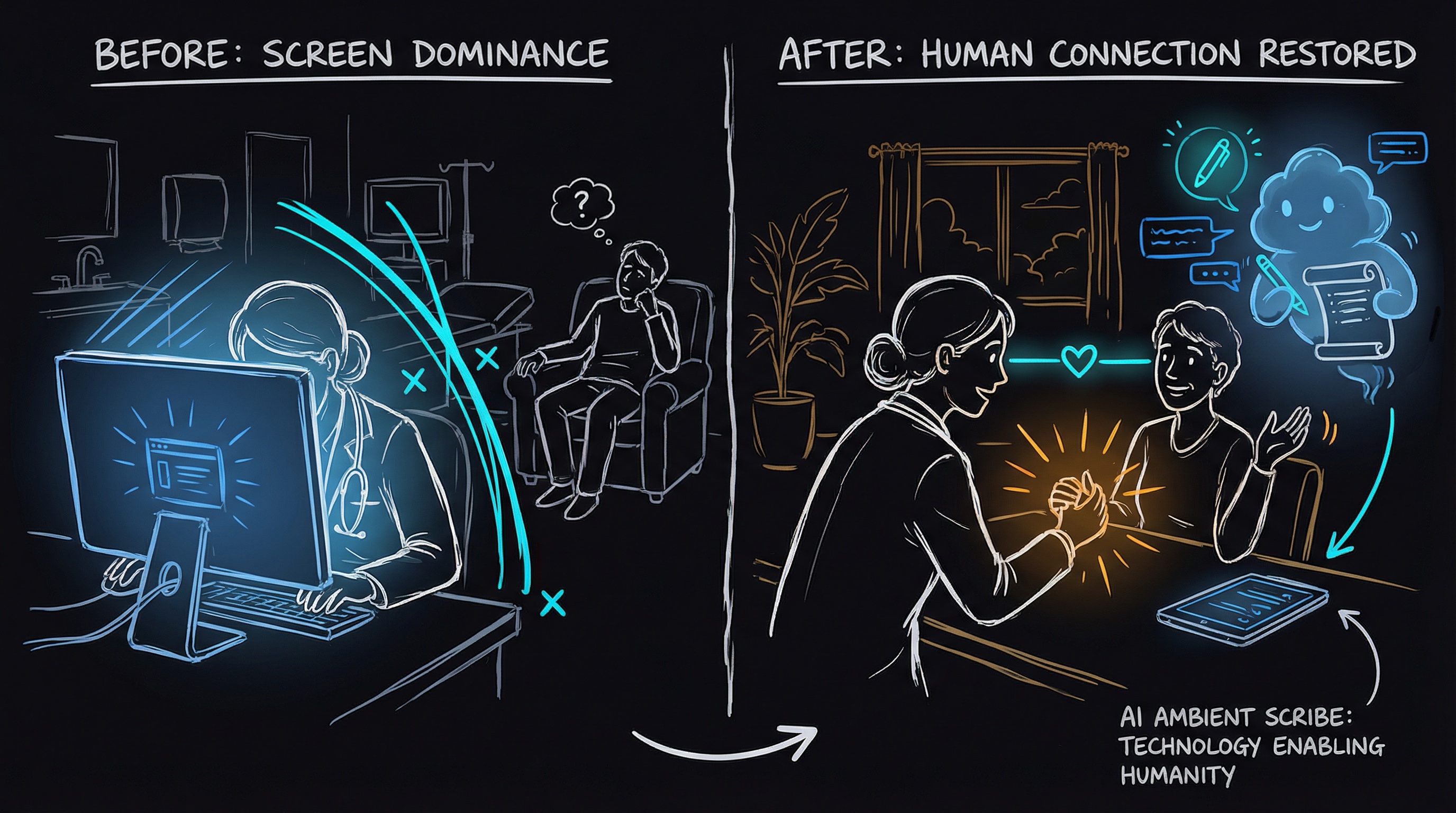
The charting problem
I used to think the EMR was just annoying. Then I saw the numbers, and “annoying” isn’t the word.
The EMR was sold as a way to streamline documentation. It did the opposite. It became the single biggest driver of provider burnout — bigger than workload, bigger than regulatory red tape, bigger than difficult colleagues.
The numbers are hard to explain away. Providers spend 37% of patient-encounter time on EMR work — typing notes, clicking checkboxes, ordering labs, and coding diagnoses. For every hour of direct patient care, physicians spend 2 hours on documentation and admin. Documentation burden is the #1 cited driver of clinician burnout.
Urgent care makes this worse. A primary-care visit is a scheduled 20–30 minute slot. An urgent-care shift is 20–25 patients walking in at random, and the charting per patient doesn’t shrink — it just piles up. By end of shift, providers are routinely 2–3 hours behind.
This stopped looking like a quality-of-life problem and started looking like a clinical-risk problem. Late notes mean:
- Incomplete charts that drop critical details.
- Coding errors that trigger claim denials (the insurer refuses to pay) and lost revenue.
- Medico-legal exposure — if the chart doesn’t match the care delivered, the lawyer has a field day.
- Burnout and turnover, which forces clinics into locum staffing (temporary doctors at premium rates) that bleeds cash.
The old fix was a human scribe who shadows the provider and types. That helps, but it costs a salary, needs training, puts a third body in the exam room, and still depends on human typing speed and attention. I pushed scribes hard for a while. They were a band-aid.
The first tool: an ambient scribe
The ambient scribe changes the workflow at the root. Instead of the provider typing or dictating to a human, an AI listens to the natural conversation between provider and patient, understands the clinical context, and writes a structured note straight into the EMR.
What happens in the room
The path is simple to describe. A microphone captures the visit, often on a phone or a small unit on the provider’s belt. Speech-to-text turns the audio into a transcript. Natural language processing (NLP) extracts the clinical structure: chief complaint (why the patient came in), history of present illness (the story of the current problem), physical exam findings, assessment (the working diagnosis), and plan (next steps). The AI fills the right EMR fields automatically. The provider reads the note, edits it, and signs off.
The word that matters is ambient. The provider doesn’t dictate in a rigid format. They just talk to the patient — “Tell me what brought you in today.” “Where does it hurt?” “Any fever or chills?” The AI listens, understands, and writes.
The part that changes the visit
Deployments show documentation time down 70%: work that took 10–12 minutes takes 3–4. Providers reclaim 1–2 hours per shift that used to go to after-hours charting. Coding accuracy improves because the AI catches billable elements (parts of the visit that can be coded for payment), including review-of-systems items, detailed exam components, and complexity factors (elements that raise the visit’s complexity rating for billing). Claim-denial rates drop because fuller notes support medical necessity (the proof insurers require that the care was actually needed).
But the number that sold me wasn’t a number. It was eye contact.
When providers aren’t typing, they’re looking at the patient. They’re catching the nonverbal stuff — the wince when you press the abdomen, the hesitation before answering a question about whether they took their meds, the parent whose anxiety doesn’t match the child’s mild symptoms.
One provider put it this way: “For the first time in 15 years, I’m having conversations with patients instead of conversations with my computer. I’m seeing body language. I’m noticing when something doesn’t add up. And I’m not staying two hours after my shift to finish notes.”
Where I watched it go wrong
Ambient scribes sound transformative. They’re not magic. They’re software, and software has edges.
HIPAA compliance and data security. Patient conversations are some of the most sensitive data there is. Any AI touching them has to be:
- HIPAA compliant with a Business Associate Agreement in place — a BAA is the contract that makes the vendor legally responsible for protecting patient data under HIPAA, the federal health-privacy law.
- Encrypted in transit and at rest. Audio recordings and transcripts must be locked down.
- Access-controlled. Only authorized personnel reach the recordings.
- Retention-limited. Audio gets deleted after the note is generated, not stored forever.
The enterprise vendors — Nuance DAX, Suki, Abridge — built for this from day one. Smaller vendors and open-source options may need more hardening. I learned this the hard way: “open-source and free” is not a compliance argument.
Patient consent and transparency. HIPAA doesn’t strictly require patient consent for AI documentation (it falls under “healthcare operations”), but transparency earns trust. The practices that work:
- Signage in the exam room — “This room uses AI-assisted documentation to improve care.”
- A verbal heads-up — “I’m using an AI assistant to help with documentation today, so I can focus on you. Is that okay?”
- An opt-out — let patients decline if they prefer.
In practice, pushback is minimal. Patients like that you’re looking at them.
Provider training and trust. Here’s where I was wrong. I thought the hard part would be the tech. It wasn’t. The hard part is clinician trust.
Providers have to believe the AI will not miss critical clinical information, that its notes will hold up under legal scrutiny, and that it will not make embarrassing errors such as the wrong patient name, the wrong diagnosis, or a sentence that makes no sense. They also have to believe they will not spend more time fixing mistakes than they saved by not typing.
Building that belief takes a phased rollout. Start with 2–3 enthusiastic early adopters instead of a forced enterprise deployment. For the first 2 weeks, generate both a human-typed note and an AI note and compare them. Clinicians report errors and omissions daily; the vendor tunes the model in response. Track and share documentation-time metrics so the time savings are visible.
At one urgent-care network, the skeptics became advocates once their charting backlog disappeared. As one physician put it: “I went home on time for the first time in three years. This isn’t hype — it’s real.”
Coding accuracy and revenue: the benefit I didn’t expect
I expected scribes to save time. I didn’t expect them to make money. They do, by fixing under-coding.
Providers routinely bill less than they earned because they don’t document every billable element. An AI trained on coding guidelines identifies:
- Review-of-systems elements that support a higher-complexity code.
- Detailed exam components that justify a 99214 instead of a 99213 — those are billing codes for an office visit, and 99214 pays 20–30% more because it denotes higher complexity.
- Time-based billing (billing by minutes spent on counseling or coordination, instead of by complexity) when counseling or care coordination exceeds the face-to-face time.
One urgent-care group reported a 12% increase in average reimbursement per encounter after deploying ambient AI scribes — not from upcoding (billing a higher-paying code than the visit warrants, which is fraud), but from accurately capturing the work already being performed.
Over 10,000 patient encounters annually, that’s hundreds of thousands in recovered revenue. The AI-scribe ROI (return on investment) turns positive within months, before you even account for lower scribing costs or improved provider retention.
The second tool: front-desk automation
The scribe fixes the clinical side. The front desk is the other bottleneck — the patient-access side, where people actually get in the door.
The work waiting at the desk
Front-desk staff verify identity, contact information, and emergency contacts. They verify insurance, including coverage, copays (the fixed dollar amount a patient owes per visit), and deductibles (what the patient pays out of pocket each year before insurance starts). They collect payments, including copays, past balances, and self-pay arrangements; schedule appointments against clinic capacity and provider schedules; answer calls about hours, insurance, and wait times; direct people to exam rooms; explain forms; and defuse frustrated patients.
That’s too much for one person. Most clinics staff 2–3 front-desk employees during peak hours. Even that isn’t enough during flu season or when multiple walk-ins arrive at once.
The result: phones go to voicemail, online inquiries get delayed responses, patients wait 10–15 minutes just to check in, and staff experience high turnover from stress and low pay.
24/7 automated engagement
AI front-desk automation handles the repetitive, high-volume tasks that consume staff time while adding minimal clinical value, at any hour.
The useful parts are repetitive work, not clinical judgment.
Online self-scheduling can use real-time availability from the EMR. SMS check-in lets a patient text an arrival, after which the AI confirms it and alerts staff. A mobile link lets patients complete intake forms before they arrive. The AI can also pull the current queue status from the EMR and give an accurate wait-time number.
Insurance verification can run through payer APIs — software hookups that let the clinic query an insurer directly instead of calling. The AI can explain copays, deductibles, and coverage limits in plain language, and handle pre-registration by verifying insurance before the patient arrives, cutting check-in time.
For payments, it can send SMS or email reminders for outstanding balances, offer a text-link payment portal for credit cards, HSA/FSA (tax-advantaged health spending accounts), or payment plans, and use automated prompts to ensure copays are collected before the visit.
For phone and chat, it can answer common questions about hours, location, insurance, and services; route complex questions to a human while handling routine ones; and support Spanish, Mandarin, and other languages without requiring multilingual staff.
The operational impact
One urgent-care network deployed AI front-desk automation across 15 locations. The results:
- Phone answer rate increased from 68% to 94% — fewer missed calls means more patients scheduled.
- Check-in time reduced by 40% — self-service check-in and pre-completed paperwork accelerate patient flow.
- Staff reassignment — front-desk employees shifted to higher-value tasks (prior-authorization support — getting the insurer’s approval before a service — complex billing inquiries, patient-experience improvement).
- After-hours scheduling increased 35% — patients can schedule at 10 PM when clinics are closed; appointments auto-populate in the EMR by morning.
The insight I keep coming back to: AI doesn’t eliminate front-desk jobs. It removes the repetitive work so staff can focus on the complex interactions that actually require human judgment, empathy, and problem-solving.
Keep the human handoff obvious
The real risk of front-desk AI is dehumanization. Healthcare is personal. Patients calling with chest pain, worried parents with sick children, elderly patients confused about insurance — these interactions need human empathy, not scripted chatbot responses.
The answer is tiered automation.
Low-stakes, high-volume questions can be fully automated: hours, location, insurance, current wait time, and appointment scheduling. These queries consume 60–70% of front-desk volume and require zero clinical judgment. AI handles them perfectly.
Moderate cases stay AI-assisted: insurance eligibility edge cases, payment-plan negotiations, constrained rescheduling, and routing between urgent care, the emergency department, and primary care. AI surfaces relevant information and suggests a response. A staff member makes the decision and talks to the patient.
Emotional or distressed patients, complex medical questions, billing disputes that need judgment, and complaints or service-recovery situations (fixing a bad patient experience) stay human-only. The AI immediately sends them to staff with full context: caller history, previous visits, and an issue summary.
The goal is not to automate everything. It is to remove the noise so staff can handle the parts that need judgment and empathy.
Patient acceptance and trust
I assumed patients would resist an AI front desk. Would they accept talking to an AI? Would elderly patients struggle with text-based check-in?
I was wrong. Real-world data says: patients don’t care about the AI. They care about speed and convenience.
- Younger patients (18–45) prefer digital self-service — they’d rather text to check in than talk to a front-desk staff member.
- Older patients (65+) appreciate phone support — as long as the AI voice is clear and responsive, they engage just fine; if they need help, they’re routed to a human immediately.
- Language barriers decrease — AI systems with multi-language support often outperform English-only human staff for non-English speakers.
One urgent-care operator summarized it: “Patients don’t come to urgent care for a relationship with the front desk. They come for fast, convenient healthcare. If AI gets them to a provider faster, they’re thrilled.”
Start where a mistake is recoverable
Both tools are real. Both need a deliberate, risk-managed rollout.
Documentation before diagnosis
The principle I’d tattoo on this: start with low-stakes AI applications before moving to high-stakes clinical decisions.
Low-stakes uses are documentation through ambient scribes, scheduling and appointment management, insurance verification, and patient FAQs and wayfinding. They have high volume, low risk, and measurable ROI. If the AI makes a mistake, the consequences are minimal: a provider can correct documentation, a staff member can reschedule an appointment, or a patient can call back for clarification.
Differential diagnosis generation — the possible conditions that could explain symptoms — treatment recommendations, high-risk clinical decision support, and triage decisions such as whether someone should go to the ED are not ready for primetime.
These require clinical judgment, carry legal liability, and have unclear regulatory status. The technology exists, but the risk-benefit calculus doesn’t yet justify deployment in most urgent-care settings. I’ll be honest: I’m not sure when it will. The math is moving, but not fast enough to bet a clinic on.
Legal liability: the unresolved question
One of the most thoughtful critiques of healthcare AI comes from Peter A. Kolbert, JD, a healthcare attorney:
“From a risk standpoint, the challenge is that the brilliant innovators driving healthcare technology often don’t understand that the ultimate endpoint of every patient interaction is liability.”
That’s the central tension in healthcare AI deployment.
What happens when AI-assisted documentation omits a critical finding that leads to a missed diagnosis?
Is the provider liable for not catching the omission? Is the vendor liable for the AI error? Is the clinic liable for deploying the technology?
The case law doesn’t exist yet. The regulatory framework is evolving. The FDA (the federal agency that regulates drugs and medical devices) has issued guidance on AI as a medical device, but much of healthcare AI falls into gray areas.
What we know today is narrower. Providers remain legally responsible for all documentation; even when AI generates the note, the clinician must review and attest to its accuracy. Vendors carry product liability, but contracts often limit that to software defects rather than clinical outcomes. And the standard of care is shifting: as AI becomes ubiquitous, failing to use AI tools may eventually constitute substandard care, much as not using EMRs became indefensible.
The practical response is to keep a human in the loop; no AI system should make autonomous clinical decisions. Note in the medical record when AI tools were used and who reviewed their outputs. Maintain quality assurance by auditing AI-generated documentation for accuracy and completeness. Buy adequate malpractice and cyber-liability insurance (the latter covers data breaches) and confirm that it covers AI-assisted workflows. Follow vendor best practices and use enterprise-grade, HIPAA-compliant systems with established track records.
Trust is the real barrier
I’ll say it again, because it’s the thing I keep underestimating: technology readiness isn’t the bottleneck. Clinician trust is.
Physicians and nurse practitioners who’ve spent decades developing their clinical intuition are skeptical of black-box AI systems. That skepticism is healthy — it’s what keeps patients safe.
Trust needs four things. Explain what data the AI was trained on, how it processes information, its limits, and when it might fail; do not present it as magic. Show internal validation studies (checks of accuracy on your own cases), error rates, performance metrics, and side-by-side AI and human comparisons. Let clinicians test it in low-risk situations. Give them control: they must be able to edit documentation, reject suggestions, or turn the system off. The moment AI feels coercive — “you must use this system” — trust evaporates. Finally, show visible time savings and quality improvements. Trust accelerates when clinicians personally experience the benefits: “I finished charting during my shift for the first time in months.” “The AI caught a diagnosis code that increased reimbursement by $40.” “I actually made eye contact with my patient instead of staring at the computer.” Those stories, shared peer-to-peer, are more persuasive than any vendor pitch.
What is coming next in 2026–2027
Ambient AI scribes and AI front-desk automation are the mature, deployable technologies of 2026. But the next wave is already emerging.
Clinical decision support for undifferentiated patients. Urgent care sees patients with vague complaints such as “I don’t feel well,” “I’m tired all the time,” or “Something’s wrong but I don’t know what.” AI systems trained on millions of encounters can surface differential diagnoses providers might not consider: “Based on the patient’s age, symptoms, and exam findings, consider thyroid dysfunction — 23% of similar presentations in the training data.” They might say, “Patient’s reported symptoms align with heart failure exacerbation — consider BNP testing” (BNP is a blood marker for heart failure). That is hypothesis generation, not diagnosis. The provider still makes every clinical decision, but AI expands the differential.
Predictive triage can help people decide between urgent care, primary care, and no care. A text or voice tool might say that a mild viral illness is appropriate for self-care, that possible appendicitis needs an emergency department within the next 2 hours, or that symptoms consistent with strep throat call for an urgent-care visit that day. This reduces inappropriate ED use (expensive and crowded) and increases urgent-care use when it is the appropriate level of care, with better margins — more profit per visit.
Real-time coding systems that monitor the encounter in real time can prompt a provider during a visit: “You’ve discussed 8 review-of-systems elements. Documenting 2 more would support a 99214 code,” or, “You’ve spent 18 minutes on counseling. Consider time-based billing for higher reimbursement.” That is not upcoding; it is a way to capture the complexity of care actually delivered.
Post-visit automation can send diagnosis-specific discharge instructions, schedule primary-care follow-ups, check in 48 hours later (“How are your symptoms? Did the medication help?”), and identify patients who need a callback because symptoms are not improving, medication side effects appeared, or a prescription was not filled. That closes the care loop without using provider or nurse time.