Monday, 4:57 PM. The waiting room went from two patients to ten in under twenty minutes, and the provider who should have been seeing patient number seven was still typing the note for patient number four. By 6:30 the clinic was dead — nurses restocking rooms nobody was using. Same building, same staff, two completely different clinics inside two hours. That’s the walk-in-only model in a single shift.
After watching this repeat, I came to believe the walk-in-only model is dying — not because appointments are better medicine, but because patients want to know when they will be seen. Clinics mixing scheduled slots with walk-in availability — the hybrid model — are dropping wait times by over 50% while pushing satisfaction to near-perfect. The fix is not turning people away. It is giving them certainty.
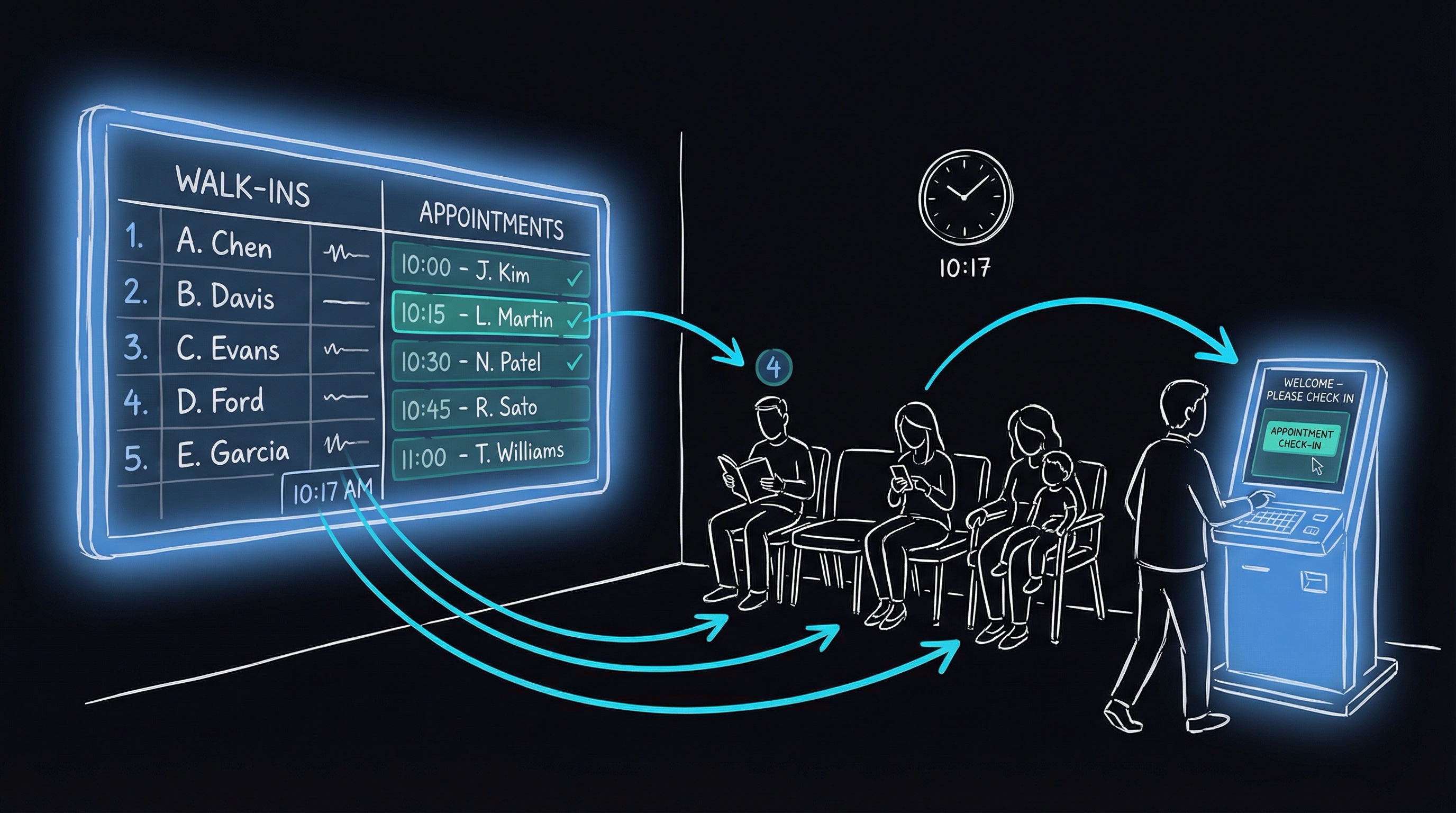
What walk-in-only does to a shift
Walk-in urgent care runs on demand you can’t predict. The bunching effect — patients arriving in clusters rather than a steady stream — is the whole game. Ten people at 2:00 PM buries the staff. Four o’clock is dead air.
- Long, unpredictable waits during the surges.
- Idle staff and empty rooms during the lulls.
- Frustrated patients who have no idea when they’ll be seen.
- Lower satisfaction scores despite care that’s clinically fine.
I used to assume the dissatisfaction was clinical — that patients rated walk-ins lower because the care felt rushed. Research out of Ontario found that patients at walk-in clinics reported significantly lower satisfaction with the waiting experience than patients in scheduled-appointment settings, even when the clinical care was identical. Same doctor, same treatment, different wait. The wait was the whole complaint.
What the hybrid model changes
MD Today Urgent Care, in San Diego, tried something I was skeptical of at first: they limited walk-ins to two per hour and filled the remaining slots with scheduled appointments. I worried they’d choke off the walk-in traffic that defines urgent care. They didn’t. The numbers were blunt:
- Average wait times dropped from 39 minutes (walk-ins) to 16 minutes (scheduled patients) — a 59% reduction.
- Patient ratings climbed to 4.8 out of 5 stars.
- Overall volume went up, without wait times climbing proportionally.
I had missed the important distinction: scheduling does not mean turning patients away. It means giving patients options — walk in now, or reserve a spot and skip the wait. Clinics running hybrid scheduling are seeing real, measurable gains in operational efficiency and patient satisfaction while maintaining the flexibility to handle whoever walks through the door.
What patients ask for
When patients pick an urgent care provider, the #1 factor isn’t bedside manner, insurance acceptance, or even location. It’s “appointments available right now.” That outranks everything.
- 54% of patients say online scheduling or check-in is “very important” in choosing a clinic.
- Patients who can reserve a spot come back more often than those who can’t.
- Wait-time perception — how long the wait feels — is the single largest driver of satisfaction scores.
Patients want access and certainty about when they will receive it. The operational complexity is real — I have watched it trip up good operators — but in a market where patients have more choices than ever, the clinic that respects their time wins.
The operating changes
The good hybrid operators I have watched do not kill walk-ins. They reserve 1–2 slots per hour for unscheduled patients. That keeps the urgent-care promise — come as you are — while bringing order to the rest of the day.
They also make the queue visible, giving patients a way to see their place in line. When someone can read “2 people ahead of you” or get a text when they are next, the perceived wait shrinks fast. I used to think the problem was the minutes. It was the uncertainty. The front desk needs a consistent script too: “We’ll get you in as soon as possible, but we do have some patients with reserved times this afternoon.” Empathy plus transparency.
The clinic’s own history shows the shape of the week. Mondays at 5:00 PM are always slammed. Wednesdays at 2:00 PM are quiet. The good operators adjust the appointment-to-walk-in ratio against those patterns instead of running one flat schedule all week.
The approach I underestimated is not a traditional appointment at all. It is “Save My Spot” virtual waiting. The patient goes online, claims a spot in line, and arrives when their turn is close. It is not a guaranteed appointment, but the clinic aims to start the visit within 15 minutes of arrival. For a lot of patients, that is the sweet spot: no appointment rigidity and no lobby.
The walk-in-only model is not dead, but it is no longer the default.
Telemedicine as overflow
One pattern I am watching closely is telehealth — video visits — as overflow capacity. When walk-in demand exceeds what the physical clinic can handle, some patients can take a video visit immediately. Patients with minor issues often prefer a screen to a lobby. The result is a parallel queue, one physical and one virtual, with staff flexing between them as demand changes.